Seasonally adjusted unemployment rates for all Utah counties have been posted online here.
Each month, these rates are posted the Monday following the Unemployment Rate Update for Utah.
For more information about seasonally adjusted rates, read a DWS analysis here.
Next update scheduled for March 26th.
Showing posts with label Data Releases. Show all posts
Showing posts with label Data Releases. Show all posts
Monday, March 5, 2018
Friday, March 2, 2018
Utah's Employment Situation for January 2018
Utah's Employment Situation for January 2018 has been released on the web.
Find the Current Economic Situation in its entirety here.
For charts and tables, including County Employment, go to the Employment and Unemployment page.
Next update scheduled for March 23rd, 2018.

Find the Current Economic Situation in its entirety here.
For charts and tables, including County Employment, go to the Employment and Unemployment page.
Next update scheduled for March 23rd, 2018.


Monday, August 3, 2015
Updated Economic Snapshots

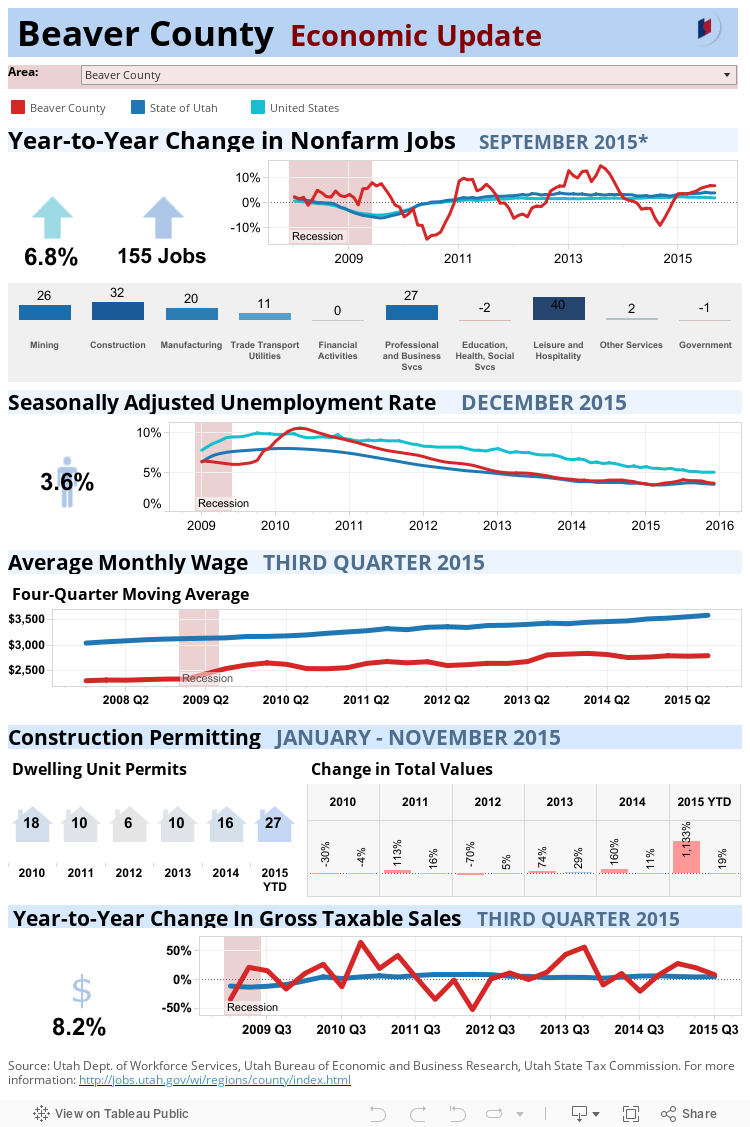
For the latest economic snapshot for your county, check out the updated files on our website for Juab, Summit, Utah and Wasatch counties.
Note: refreshing browser may be necessary for current information.
Wednesday, April 29, 2015
Mountainland Economic Update
Jim Robson, Regional Economist
Economic conditions in the Mountainland Service Area (Utah, Juab, Wasatch and Summit Counties) are very favorable with a vibrant year-over job growth of 4.5 percent, or 10,892 new jobs, from December 2013 to December 2014. Job growth and other indicators show that the economy is well into its fifth year of expansion. There has been job growth in most major industry sectors with particular strength among the wholesale and retail trade, construction, professional/scientific/technical services and health care industries. Unemployment in the region has subsided considerably from the recessionary peak of 7.6 percent at the end of 2009 to average 3.0 percent in the first quarter of 2015.
Utah, Summit, Wasatch and Juab Counties’ continuing job growth and favorable labor market conditions are expected to persist through 2015. Based on the strength of employment growth in recent years, new job opportunities should increase between four to five percent and low unemployment will continue to characterize this area.
Utah County
* In December 2014, the number of payroll jobs in Utah County increased on average by 4.8 percent over December 2013, with 10,010 new positions. New employment growth has occurred in 16 of 19 major industrial sectors.
* The most new jobs were added by the trade industry with 1,984 additional jobs, a year-over increase of 6.2 percent. Two-thirds of these new positions were in direct marketing and electronic shopping firms.
* Construction industry jobs increased by 13.2 percent in the twelve months ending in December 2014 with 1,967 new positions. Residential housing construction activities provided 3 out every 4 new construction jobs. There were 4,946 dwelling units permited in 2014, a 52.6 percent increase.
* This new construction activity is reflected in related industries such as building material, garden supply, and furniture stores, and real estate services, each of which also experienced healthy job gains.
* In addition to the trade and construction jobs, five other private sector industries added between 531 and 1,514 new jobs over the 12 months ending in December 2014. Leading this list is professional, scientific, technical services which grew 9.7 percent, or 1,514 jobs— computer systems design being responsible for two-thirds of the new job opportunities.
* Healthcare and social assistance contributed 981 new positions, increasing by 4.4 percent. Information (mostly publishing and telecommunications) grew by 8.6 percent or 844 positions. Food services contributed 572 new jobs.
* Finally, with the tight labor market and low unemployment, the employment services industry added 531 positions increasing by 13.5 percent.
* The unemployment rate in Utah County has declined to a low level of just three percent in the first quarter of 2015 compared to 3.7 percent a year earlier. Initial claims for unemployment benefits through March 2015, while still above the levels seen prior to the recession, are at their lowest level in over six years.
* Utah County employment is expected to continue with strong job growth in 2015 at about 4.9 percent, adding on average between 9,000 to 11,000 new positions.
* Major continuing contributors to the robust Utah County economy will be construction, trade, professional/scientific/technical services and information services.
Summit County
* From December 2013 to December 2014, Summit County added 525 new jobs for a year-over increase of 2 percent. This end-of-year growth rate is lower than the more robust job growth of 4.1 percent achieved earlier in the year.
* Overall Summit’s labor market continued to exhibit balanced expansion in the fourth quarter of 2014 with most major industries producing new jobs.
* Construction contributed 262 new jobs with growth of 21.4 percent. Other significant contributors to employment increases were headquarters offices with 164 jobs, professional/scientific/technical services with 102 jobs, wholesale and retail trade with 99 jobs, healthcare/social services with 81 jobs, and finance/insurance with 75 jobs.
* The only major industry group with significant job reductions in December 2014 compared to December 2013 was leisure and hospitality. Within this industry group accommodations shed 387 positions and skiing facilities dropped by 145 compared to a year earlier as the warm and dry weather reduced winter recreation.
* For the fourth quarter of 2014 there was a net increase of 3.6 percent in firms and worksites within Summit County. This increase of 89 units brought the total count of firms and worksites to 2,594.
* The jobless rate in Summit topped out at 7.6 percent in summer of 2010 as a result of the recession. It has since receded to a favorable rate of 3.1 percent where it remains through the first quarter of 2015. On a seasonally-adjusted basis, there are currently about 700 unemployed Summit County residents for any given month. Initial claims for unemployment benefits are at six-year lows.
* Summit’s actual job growth of around 981 on average in 2014 is well above the 713 experienced in 2013. Employment gains among the majority of industry sectors will continue in 2015. Overall job growth in 2015 should be somewhat less than last year adding from 650 to 800 net new jobs or around three percent.
Wasatch County
* Employment growth in Wasatch County from December 2013 to December 2014 was a solid 4.3 percent with new jobs added in 13 of 19 industry sectors. The largest industry employment increases in Wasatch County occurred in professional/scientific/technical services with 98 new jobs, up by 35.3 percent. But that increase was partially offset by a loss of 46 jobs in administrative support/waste management services. Construction employment increased by 84 positions. Health care and social assistance services contributed 64 additional jobs.
* For the year ending in the fourth quarter of 2014 there was a net increase of 3.9 percent in firms and worksites within Wasatch County. This increase of 35 units brought the total count of firms and worksites to 940.
* The Wasatch County unemployment rate was estimated at 3.2 percent in the first quarter of 2015. During the recession, unemployment peaked in Wasatch at 8.8 percent in November 2009.
* In 2013, jobs grew by 7.6 percent and job growth was 7.1 percent in 2014. Wasatch County is expected to maintain a favorable labor market through 2015, though the rapid growth of the past two years will likely moderate to a still healthy increase of around 4.3 percent.
Juab County
* In the year ending December 2014, Juab County had a total of 3,334 nonfarm payroll jobs, 52 more than in December 2013.
* Industry sectors with significant job reductions were: manufacturing (-25), professional/scientific/technical (-21), mining (-14) and arts/entertainment/recreation (-13).
* Significant new positions were added by healthcare/social services (+44), construction (+36), food services (+34), and services to buildings/dwellings (+18).
* For the fourth quarter of 2014 there was a net decrease of 0.7 percent in firms and worksites within Juab County. This reduction of two units brought the total count of firms and worksites to 276.
* In March 2015, the unemployment rate in Juab County was estimated to be 3.6 percent, down from 4.3 percent in March 2014. An estimated 179 workers were unemployed in March compared to 205 a year earlier.
* Average annual jobs fell in 2014 by one percent or 34 positions less than in 2013. For 2015 the employment outlook brightens with expected growth of around 3.1 percent or an additional 100 net new positions.
Economic conditions in the Mountainland Service Area (Utah, Juab, Wasatch and Summit Counties) are very favorable with a vibrant year-over job growth of 4.5 percent, or 10,892 new jobs, from December 2013 to December 2014. Job growth and other indicators show that the economy is well into its fifth year of expansion. There has been job growth in most major industry sectors with particular strength among the wholesale and retail trade, construction, professional/scientific/technical services and health care industries. Unemployment in the region has subsided considerably from the recessionary peak of 7.6 percent at the end of 2009 to average 3.0 percent in the first quarter of 2015.
Utah, Summit, Wasatch and Juab Counties’ continuing job growth and favorable labor market conditions are expected to persist through 2015. Based on the strength of employment growth in recent years, new job opportunities should increase between four to five percent and low unemployment will continue to characterize this area.
Utah County
* In December 2014, the number of payroll jobs in Utah County increased on average by 4.8 percent over December 2013, with 10,010 new positions. New employment growth has occurred in 16 of 19 major industrial sectors.
* The most new jobs were added by the trade industry with 1,984 additional jobs, a year-over increase of 6.2 percent. Two-thirds of these new positions were in direct marketing and electronic shopping firms.
* Construction industry jobs increased by 13.2 percent in the twelve months ending in December 2014 with 1,967 new positions. Residential housing construction activities provided 3 out every 4 new construction jobs. There were 4,946 dwelling units permited in 2014, a 52.6 percent increase.
* This new construction activity is reflected in related industries such as building material, garden supply, and furniture stores, and real estate services, each of which also experienced healthy job gains.
* In addition to the trade and construction jobs, five other private sector industries added between 531 and 1,514 new jobs over the 12 months ending in December 2014. Leading this list is professional, scientific, technical services which grew 9.7 percent, or 1,514 jobs— computer systems design being responsible for two-thirds of the new job opportunities.
* Healthcare and social assistance contributed 981 new positions, increasing by 4.4 percent. Information (mostly publishing and telecommunications) grew by 8.6 percent or 844 positions. Food services contributed 572 new jobs.
* Finally, with the tight labor market and low unemployment, the employment services industry added 531 positions increasing by 13.5 percent.
* The unemployment rate in Utah County has declined to a low level of just three percent in the first quarter of 2015 compared to 3.7 percent a year earlier. Initial claims for unemployment benefits through March 2015, while still above the levels seen prior to the recession, are at their lowest level in over six years.
* Utah County employment is expected to continue with strong job growth in 2015 at about 4.9 percent, adding on average between 9,000 to 11,000 new positions.
* Major continuing contributors to the robust Utah County economy will be construction, trade, professional/scientific/technical services and information services.
Summit County
* From December 2013 to December 2014, Summit County added 525 new jobs for a year-over increase of 2 percent. This end-of-year growth rate is lower than the more robust job growth of 4.1 percent achieved earlier in the year.
* Overall Summit’s labor market continued to exhibit balanced expansion in the fourth quarter of 2014 with most major industries producing new jobs.
* Construction contributed 262 new jobs with growth of 21.4 percent. Other significant contributors to employment increases were headquarters offices with 164 jobs, professional/scientific/technical services with 102 jobs, wholesale and retail trade with 99 jobs, healthcare/social services with 81 jobs, and finance/insurance with 75 jobs.
* The only major industry group with significant job reductions in December 2014 compared to December 2013 was leisure and hospitality. Within this industry group accommodations shed 387 positions and skiing facilities dropped by 145 compared to a year earlier as the warm and dry weather reduced winter recreation.
* For the fourth quarter of 2014 there was a net increase of 3.6 percent in firms and worksites within Summit County. This increase of 89 units brought the total count of firms and worksites to 2,594.
* The jobless rate in Summit topped out at 7.6 percent in summer of 2010 as a result of the recession. It has since receded to a favorable rate of 3.1 percent where it remains through the first quarter of 2015. On a seasonally-adjusted basis, there are currently about 700 unemployed Summit County residents for any given month. Initial claims for unemployment benefits are at six-year lows.
* Summit’s actual job growth of around 981 on average in 2014 is well above the 713 experienced in 2013. Employment gains among the majority of industry sectors will continue in 2015. Overall job growth in 2015 should be somewhat less than last year adding from 650 to 800 net new jobs or around three percent.
Wasatch County
* Employment growth in Wasatch County from December 2013 to December 2014 was a solid 4.3 percent with new jobs added in 13 of 19 industry sectors. The largest industry employment increases in Wasatch County occurred in professional/scientific/technical services with 98 new jobs, up by 35.3 percent. But that increase was partially offset by a loss of 46 jobs in administrative support/waste management services. Construction employment increased by 84 positions. Health care and social assistance services contributed 64 additional jobs.
* For the year ending in the fourth quarter of 2014 there was a net increase of 3.9 percent in firms and worksites within Wasatch County. This increase of 35 units brought the total count of firms and worksites to 940.
* The Wasatch County unemployment rate was estimated at 3.2 percent in the first quarter of 2015. During the recession, unemployment peaked in Wasatch at 8.8 percent in November 2009.
* In 2013, jobs grew by 7.6 percent and job growth was 7.1 percent in 2014. Wasatch County is expected to maintain a favorable labor market through 2015, though the rapid growth of the past two years will likely moderate to a still healthy increase of around 4.3 percent.
Juab County
* In the year ending December 2014, Juab County had a total of 3,334 nonfarm payroll jobs, 52 more than in December 2013.
* Industry sectors with significant job reductions were: manufacturing (-25), professional/scientific/technical (-21), mining (-14) and arts/entertainment/recreation (-13).
* Significant new positions were added by healthcare/social services (+44), construction (+36), food services (+34), and services to buildings/dwellings (+18).
* For the fourth quarter of 2014 there was a net decrease of 0.7 percent in firms and worksites within Juab County. This reduction of two units brought the total count of firms and worksites to 276.
* In March 2015, the unemployment rate in Juab County was estimated to be 3.6 percent, down from 4.3 percent in March 2014. An estimated 179 workers were unemployed in March compared to 205 a year earlier.
* Average annual jobs fell in 2014 by one percent or 34 positions less than in 2013. For 2015 the employment outlook brightens with expected growth of around 3.1 percent or an additional 100 net new positions.
Monday, March 9, 2015
Monthly Consumer Price Index (CPI) updated
The Consumer Price Indexes (CPI) program produces monthly data on changes in the prices paid by urban consumers for a representative basket of goods and services.
There is no CPI data specific to Utah, so national data is relied upon for this page.
For monthly and annual CPI data see here.
There is no CPI data specific to Utah, so national data is relied upon for this page.
For monthly and annual CPI data see here.
Thursday, February 12, 2015
Juab County Economic Update
Jim Robson, Economist
Low Unemployment and Sustainable Growth
Economic conditions in the Mountainland Economic Service Area (Utah, Juab, Wasatch and Summit Counties) are bright with strong year-over job growth of 4.2 percent, or 9,890 new jobs from September 2013 to September 2014. This is a bit of a slowdown from 2013, when average payroll job growth in the region was a very rapid 5.2 percent above the average level of employment in 2012. There have been job increases in most major industry sectors with particular strength among professional/technical services, wholesale and retail trade, construction, food services and health care.
Utah, Summit, Wasatch and Juab Counties’ sustainable job growth and favorable labor market conditions persisted through the end of 2014 and are continuing into 2015. By December of 2014, the unemployment rate in Mountainland declined to a very favorable rate of 3.3 percent. A year ago the regional unemployment rate was 3.8 percent. Based on the strength of employment growth in recent years, job opportunities and low unemployment will continue to characterize this area. Job growth for 2015 will likely climb between 3.7 to 4.3 percent.
Juab County
• In the year ending September 2014, Juab County had a total of 3,379 nonfarm payroll jobs, 6 more than in September 2013.
• Industry sectors that had significant job reductions were construction (-80), professional/scientific/technical (-25), and transportation (-10). The decline in construction was a result of reduced commercial construction activity.
• Significant new positions were added by manufacturing (+36), health care/social assistance (+21), local government (+16), and food services (+12).
• For the year ending in September 2014 there was a net decrease of 2.1 percent in firms and worksites within Juab County. This reduction of 6 units brought the total count of firms and worksites to 274.
• In December 2014, the unemployment rate in Juab County was estimated to be 3.8 percent, down from 4.8 percent in December 2013. An estimated 164 workers were unemployed in December compared to 213 a year earlier.
• Average annual job growth in 2013 was 6.3 percent or 193 new jobs above 2012. The 2014 preliminary annual average estimate indicates that Juab County had net job reductions of about 47 positions, a loss of 1.4 percent.
Low Unemployment and Sustainable Growth
Economic conditions in the Mountainland Economic Service Area (Utah, Juab, Wasatch and Summit Counties) are bright with strong year-over job growth of 4.2 percent, or 9,890 new jobs from September 2013 to September 2014. This is a bit of a slowdown from 2013, when average payroll job growth in the region was a very rapid 5.2 percent above the average level of employment in 2012. There have been job increases in most major industry sectors with particular strength among professional/technical services, wholesale and retail trade, construction, food services and health care.
Utah, Summit, Wasatch and Juab Counties’ sustainable job growth and favorable labor market conditions persisted through the end of 2014 and are continuing into 2015. By December of 2014, the unemployment rate in Mountainland declined to a very favorable rate of 3.3 percent. A year ago the regional unemployment rate was 3.8 percent. Based on the strength of employment growth in recent years, job opportunities and low unemployment will continue to characterize this area. Job growth for 2015 will likely climb between 3.7 to 4.3 percent.
Juab County
• In the year ending September 2014, Juab County had a total of 3,379 nonfarm payroll jobs, 6 more than in September 2013.
• Industry sectors that had significant job reductions were construction (-80), professional/scientific/technical (-25), and transportation (-10). The decline in construction was a result of reduced commercial construction activity.
• Significant new positions were added by manufacturing (+36), health care/social assistance (+21), local government (+16), and food services (+12).
• For the year ending in September 2014 there was a net decrease of 2.1 percent in firms and worksites within Juab County. This reduction of 6 units brought the total count of firms and worksites to 274.
• In December 2014, the unemployment rate in Juab County was estimated to be 3.8 percent, down from 4.8 percent in December 2013. An estimated 164 workers were unemployed in December compared to 213 a year earlier.
• Average annual job growth in 2013 was 6.3 percent or 193 new jobs above 2012. The 2014 preliminary annual average estimate indicates that Juab County had net job reductions of about 47 positions, a loss of 1.4 percent.
Wasatch County Economic Update
Jim Robson, Economist
Low Unemployment and Sustainable Growth
Economic conditions in the Mountainland Economic Service Area (Utah, Juab, Wasatch and Summit Counties) are bright with strong year-over job growth of 4.2 percent, or 9,890 new jobs from September 2013 to September 2014. This is a bit of a slowdown from 2013, when average payroll job growth in the region was a very rapid 5.2 percent above the average level of employment in 2012. There have been job increases in most major industry sectors with particular strength among professional/technical services, wholesale and retail trade, construction, food services and health care.
Utah, Summit, Wasatch and Juab Counties’ sustainable job growth and favorable labor market conditions persisted through the end of 2014 and are continuing into 2015. By December of 2014, the unemployment rate in Mountainland declined to a very favorable rate of 3.3 percent. A year ago the regional unemployment rate was 3.8 percent. Based on the strength of employment growth in recent years, job opportunities and low unemployment will continue to characterize this area. Job growth for 2015 will likely climb between 3.7 to 4.3 percent.
Wasatch County
• Employment growth in Wasatch County from September 2013 to September 2014 continued at an energetic pace of 5.7 percent.
• The largest industry job increases occurred in construction with 129, up by 14.2 percent. Professional, scientific and technical services added 82 new jobs, most occurring in computer systems design, architecture, engineering, accounting and bookkeeping. Local government positions increased by 64 or 6.4 percent. Accommodations and food services rounded out the top four industries with 53 new jobs.
• For the year ending in September 2014 there was a net increase of 4.1 percent in firms and worksites within Wasatch County. This increase of 36 units brought the total count of firms and worksites to 916.
• The Wasatch County jobless rate was estimated at 3.5 percent in December 2014, down from 4.7 percent a year earlier. An estimated 396 workers were unemployed in December compared to 513 twelve months ago.
• Wasatch County maintained a favorable labor market through the end of 2014 adding to employment on average for the year by 540 jobs, about 8 percent.
Low Unemployment and Sustainable Growth
Economic conditions in the Mountainland Economic Service Area (Utah, Juab, Wasatch and Summit Counties) are bright with strong year-over job growth of 4.2 percent, or 9,890 new jobs from September 2013 to September 2014. This is a bit of a slowdown from 2013, when average payroll job growth in the region was a very rapid 5.2 percent above the average level of employment in 2012. There have been job increases in most major industry sectors with particular strength among professional/technical services, wholesale and retail trade, construction, food services and health care.
Utah, Summit, Wasatch and Juab Counties’ sustainable job growth and favorable labor market conditions persisted through the end of 2014 and are continuing into 2015. By December of 2014, the unemployment rate in Mountainland declined to a very favorable rate of 3.3 percent. A year ago the regional unemployment rate was 3.8 percent. Based on the strength of employment growth in recent years, job opportunities and low unemployment will continue to characterize this area. Job growth for 2015 will likely climb between 3.7 to 4.3 percent.
Wasatch County
• Employment growth in Wasatch County from September 2013 to September 2014 continued at an energetic pace of 5.7 percent.
• The largest industry job increases occurred in construction with 129, up by 14.2 percent. Professional, scientific and technical services added 82 new jobs, most occurring in computer systems design, architecture, engineering, accounting and bookkeeping. Local government positions increased by 64 or 6.4 percent. Accommodations and food services rounded out the top four industries with 53 new jobs.
• For the year ending in September 2014 there was a net increase of 4.1 percent in firms and worksites within Wasatch County. This increase of 36 units brought the total count of firms and worksites to 916.
• The Wasatch County jobless rate was estimated at 3.5 percent in December 2014, down from 4.7 percent a year earlier. An estimated 396 workers were unemployed in December compared to 513 twelve months ago.
• Wasatch County maintained a favorable labor market through the end of 2014 adding to employment on average for the year by 540 jobs, about 8 percent.
Summit County Economic Update
Jim Robson, Economist
Low Unemployment and Sustainable Growth
Economic conditions in the Mountainland Economic Service Area (Utah, Juab, Wasatch and Summit Counties) are bright with strong year-over job growth of 4.2 percent, or 9,890 new jobs from September 2013 to September 2014. This is a bit of a slowdown from 2013, when average payroll job growth in the region was a very rapid 5.2 percent above the average level of employment in 2012. There have been job increases in most major industry sectors with particular strength among professional/technical services, wholesale and retail trade, construction, food services and health care.
Utah, Summit, Wasatch and Juab Counties’ sustainable job growth and favorable labor market conditions persisted through the end of 2014 and are continuing into 2015. By December of 2014, the unemployment rate in Mountainland declined to a very favorable rate of 3.3 percent. A year ago the regional unemployment rate was 3.8 percent. Based on the strength of employment growth in recent years, job opportunities and low unemployment will continue to characterize this area. Job growth for 2015 will likely climb between 3.7 to 4.3 percent.
Summit County
• From September 2013 to September 2014, Summit County added 1,065 new jobs for a year-over increase of 4.9 percent. Summit’s labor market continued to exhibit balanced growth with most major industries producing new positions.
• Accommodations and food services employment increased the most by 224 jobs. Construction grew a healthy 13.7 percent adding 181 new jobs. Local government provided a 6 percent increase of 142 positions, with health care and social services adding 90, at 8.4 percent growth. Professional/scientific/technical grew by 8.9 percent or 88 new jobs.
• Most other industry subdivisions contributed new positions as economic growth was very broad based.
• For the year ending in September 2014 there was a net increase of 3.9 percent in firms and worksites within Summit County. This increase of 95 units brought the total count of firms and worksites to 2,535.
• The seasonally adjusted unemployment rate in Summit County was 3.1 percent in December 2014, an estimated 716 unemployed workers. A year earlier the unemployment rate was 3.7 percent.
• Employment gains among the majority of Summit County industry sectors are expected to continue. Overall job growth in 2014 was about 1,170 or in the neighborhood of 5.0 percent. This is a pick-up in economic activity from Summit County’s employment growth of 713 in 2013 and 791 new jobs created in 2012.
Low Unemployment and Sustainable Growth
Economic conditions in the Mountainland Economic Service Area (Utah, Juab, Wasatch and Summit Counties) are bright with strong year-over job growth of 4.2 percent, or 9,890 new jobs from September 2013 to September 2014. This is a bit of a slowdown from 2013, when average payroll job growth in the region was a very rapid 5.2 percent above the average level of employment in 2012. There have been job increases in most major industry sectors with particular strength among professional/technical services, wholesale and retail trade, construction, food services and health care.
Utah, Summit, Wasatch and Juab Counties’ sustainable job growth and favorable labor market conditions persisted through the end of 2014 and are continuing into 2015. By December of 2014, the unemployment rate in Mountainland declined to a very favorable rate of 3.3 percent. A year ago the regional unemployment rate was 3.8 percent. Based on the strength of employment growth in recent years, job opportunities and low unemployment will continue to characterize this area. Job growth for 2015 will likely climb between 3.7 to 4.3 percent.
Summit County
• From September 2013 to September 2014, Summit County added 1,065 new jobs for a year-over increase of 4.9 percent. Summit’s labor market continued to exhibit balanced growth with most major industries producing new positions.
• Accommodations and food services employment increased the most by 224 jobs. Construction grew a healthy 13.7 percent adding 181 new jobs. Local government provided a 6 percent increase of 142 positions, with health care and social services adding 90, at 8.4 percent growth. Professional/scientific/technical grew by 8.9 percent or 88 new jobs.
• Most other industry subdivisions contributed new positions as economic growth was very broad based.
• For the year ending in September 2014 there was a net increase of 3.9 percent in firms and worksites within Summit County. This increase of 95 units brought the total count of firms and worksites to 2,535.
• The seasonally adjusted unemployment rate in Summit County was 3.1 percent in December 2014, an estimated 716 unemployed workers. A year earlier the unemployment rate was 3.7 percent.
• Employment gains among the majority of Summit County industry sectors are expected to continue. Overall job growth in 2014 was about 1,170 or in the neighborhood of 5.0 percent. This is a pick-up in economic activity from Summit County’s employment growth of 713 in 2013 and 791 new jobs created in 2012.
Utah County Economic Update
Jim Robson, Economist
Low Unemployment and Sustainable Growth
Economic conditions in the Mountainland Economic Service Area (Utah, Juab, Wasatch and Summit Counties) are bright with strong year-over job growth of 4.2 percent, or 9,890 new jobs from September 2013 to September 2014. This is a bit of a slowdown from 2013, when average payroll job growth in the region was a very rapid 5.2 percent above the average level of employment in 2012. There have been job increases in most major industry sectors with particular strength among professional/technical services, wholesale and retail trade, construction, food services and health care.
Utah, Summit, Wasatch and Juab Counties’ sustainable job growth and favorable labor market conditions persisted through the end of 2014 and are continuing into 2015. By December of 2014, the unemployment rate in Mountainland declined to a very favorable rate of 3.3 percent. A year ago the regional unemployment rate was 3.8 percent. Based on the strength of employment growth in recent years, job opportunities and low unemployment will continue to characterize this area. Job growth for 2015 will likely climb between 3.7 to 4.3 percent.
Utah County
• In September 2014, the number of payroll jobs in Utah County increased by 4.1 percent over September 2013, with 8,421 new positions. New employment growth has occurred in most major industrial sectors.
• The trade industry added the greatest number of new jobs with 1,846 positions, a year-over increase of 6.1 percent. Most subdivisions of wholesale and retail trade experienced growth, however, nonstore retailers alone accounted for about one-half of the new jobs.
• Professional/scientific/technical services grew 12.2 percent, or 1,704 jobs. Computer systems design, management consulting and technical consulting services were responsible for most of the new opportunities.
• Construction added 1,193 positions, expanding by 7.5 percent. The majority of these new jobs were in residential housing construction.
• This solid construction activity is reflected in related industries such as building materials/garden supply stores, furniture stores, wood product manufacturing and furniture manufacturing, each of which also experienced healthy employment gains.
• Healthcare and social assistance contributed 1,066 new positions, increasing by 6.6 percent.
• Restaurants, food services and accommodations added 985 jobs, growing by 6.9 percent.
• For the year ending in September 2014 there was a net increase of 3.3 percent in firms and worksites within Utah County. This increase of 434 units brought the total count of firms and worksites to 13,726.
• The seasonally adjusted unemployment rate in Utah County was 3.3 percent in December 2014, an estimated 7,980 unemployed workers. A year earlier the unemployment rate was 3.9 percent.
• Utah County average payroll employment was estimated to have grown in 2014 by about 3.7 percent, adding 7,400 new jobs, with a similar overall job growth performance expected in 2015.
Low Unemployment and Sustainable Growth
Economic conditions in the Mountainland Economic Service Area (Utah, Juab, Wasatch and Summit Counties) are bright with strong year-over job growth of 4.2 percent, or 9,890 new jobs from September 2013 to September 2014. This is a bit of a slowdown from 2013, when average payroll job growth in the region was a very rapid 5.2 percent above the average level of employment in 2012. There have been job increases in most major industry sectors with particular strength among professional/technical services, wholesale and retail trade, construction, food services and health care.
Utah, Summit, Wasatch and Juab Counties’ sustainable job growth and favorable labor market conditions persisted through the end of 2014 and are continuing into 2015. By December of 2014, the unemployment rate in Mountainland declined to a very favorable rate of 3.3 percent. A year ago the regional unemployment rate was 3.8 percent. Based on the strength of employment growth in recent years, job opportunities and low unemployment will continue to characterize this area. Job growth for 2015 will likely climb between 3.7 to 4.3 percent.
Utah County
• In September 2014, the number of payroll jobs in Utah County increased by 4.1 percent over September 2013, with 8,421 new positions. New employment growth has occurred in most major industrial sectors.
• The trade industry added the greatest number of new jobs with 1,846 positions, a year-over increase of 6.1 percent. Most subdivisions of wholesale and retail trade experienced growth, however, nonstore retailers alone accounted for about one-half of the new jobs.
• Professional/scientific/technical services grew 12.2 percent, or 1,704 jobs. Computer systems design, management consulting and technical consulting services were responsible for most of the new opportunities.
• Construction added 1,193 positions, expanding by 7.5 percent. The majority of these new jobs were in residential housing construction.
• This solid construction activity is reflected in related industries such as building materials/garden supply stores, furniture stores, wood product manufacturing and furniture manufacturing, each of which also experienced healthy employment gains.
• Healthcare and social assistance contributed 1,066 new positions, increasing by 6.6 percent.
• Restaurants, food services and accommodations added 985 jobs, growing by 6.9 percent.
• For the year ending in September 2014 there was a net increase of 3.3 percent in firms and worksites within Utah County. This increase of 434 units brought the total count of firms and worksites to 13,726.
• The seasonally adjusted unemployment rate in Utah County was 3.3 percent in December 2014, an estimated 7,980 unemployed workers. A year earlier the unemployment rate was 3.9 percent.
• Utah County average payroll employment was estimated to have grown in 2014 by about 3.7 percent, adding 7,400 new jobs, with a similar overall job growth performance expected in 2015.
Monday, October 27, 2014
364 Manufacturing Reports from Economic Census Industry Series
In recognition of Manufacturing Day on October 3, the Census Bureau presents descriptions of its wide array of data products on the manufacturing sector of the economy. Additionally, statistics on all 364 industries in the manufacturing sector are now available from the 2012 Economic Census.
Data includes:
Also released is a county-level thematic map (right) showing the percentage of the civilian employed population employed in manufacturing jobs.
For more information including links, see the U.S. Census Bureau.
 |
| Click to enlarge |
- 2012 Economic Census Industry Series
- 2012 County Business Patterns
- Annual Survey of Manufactures
- Survey of Plant Capacity Utilization
- Manufacturers’ Shipments, Inventories, and Orders (M3)
- U.S. International Trade in Goods
- Additional Economic Indicators
Also released is a county-level thematic map (right) showing the percentage of the civilian employed population employed in manufacturing jobs.
For more information including links, see the U.S. Census Bureau.
Wednesday, September 17, 2014
Cost of Living Index for urban areas
Assume that you received a job offer in a different city and weren’t sure about how the cost of living compared to each other. Will you receive more (or less) after-taxes income and will it maintain (or sustain) your present lifestyle in your new location? The Council for Community and Economic Research supplies comparative data for urban areas on a quarterly basis, and areas surveyed include those where organizations have volunteered to participate.
See Utah’s current identified cities below:

For more about the cost of living index, visit our site and C2ER.
See Utah’s current identified cities below:
For more about the cost of living index, visit our site and C2ER.
Tuesday, July 22, 2014
New County Pages
 See our new County Pages, each with their own URL for easy bookmarking. Find labor market information that has been divided into counties and regions for a quick look at each area.
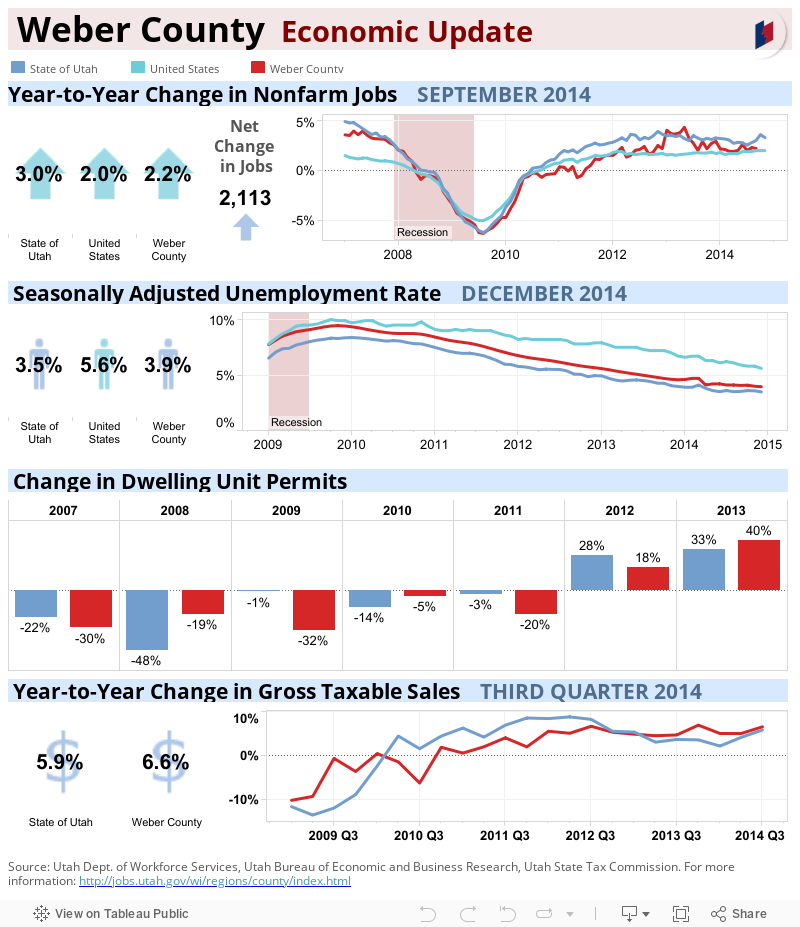
Also find a new look for the Current Economic Snapshots (Juab, Summit, Utah and Wasatch). These are economic snapshots are a two-page look at the current information for labor force, sales, building and unemployment insurance for each county in Utah, and are updated monthly after the Employment Situation.
These can be accessed on the Utah Economic Data page or on the Labor Market page under the "County Snapshots" link.
Monday, June 9, 2014
Long-term Industry Projections available on the web
Job seekers who make decisions based on labor trends information are more likely to see payoff for their efforts. An important aspect of career exploration is understanding how occupations and industries are expected to change. To assist in this process, the Department of Workforce Services (DWS) produces long-term industry projections every two years for the major industry sectors in Utah, providing information on the state’s expected labor demands. The long-term projections extend ten years past the base year. Using the industry projections, DWS generates occupational projections for jobs that fall into the industry categories.
To access the most recent set of long-term industry projections, click here.
To access the most recent set of long-term industry projections, click here.
Friday, May 16, 2014
New Data Available in Utah Economic Data Viewer
The 2013, Q4 industry employment and wages data has been updated in the Utah Economic Data Viewer. Industry employment and wage data is collected through the Quarterly Census of Employment and Wages (QCEW) program. The primary source for QCEW data are the reports submitted by employers to the Utah Unemployment Insurance program.
The Utah Department of Workforce Services compiles quarterly employment and wage data for non-agricultural employers in Utah. Data is maintained at the establishment level (e.g., store, plant, or other type of permanent worksite facility). Since these establishments are assigned an industry and county code, their employment and wage data can be aggregated into common industry and county groupings for analysis purposes.
The Utah Department of Workforce Services compiles quarterly employment and wage data for non-agricultural employers in Utah. Data is maintained at the establishment level (e.g., store, plant, or other type of permanent worksite facility). Since these establishments are assigned an industry and county code, their employment and wage data can be aggregated into common industry and county groupings for analysis purposes.
Tuesday, January 7, 2014
Utah Employers, Employment and Wages by Size, 2013
The Utah Department of Workforce Services compiles quarterly employment and wage data for non-agricultural employers in Utah. Data is maintained at the establishment level (e.g., store, plant, or other type of permanent worksite facility). Since these establishments are assigned an industry and county code, their employment and wage data can be aggregated into common industry and county groupings for analysis purposes.
Employment and wage data for Utah’s non-agricultural employers are categorized in this publication by employment size for the month of March in each of the designated years. Grouping data by this criterion provides a useful tool to analyze the characteristics of Utah employers. For example, general trends of the size of Utah employers and employment concentrations by employer size class can be observed. Wage levels for large, medium, and small firms can also be evaluated.
In this publication, data is presented for both establishments and firms. The term "establishment" is generally defined as a specific physical worksite for an employer. For most employers, this is the actual street location at which business is conducted. For others, with no permanent worksite (such as salespeople, factory representatives, or distributors) it is the location from which they conduct their business (sometimes even residences).
For an overview of this publication and a look at your county, click here.
Employment and wage data for Utah’s non-agricultural employers are categorized in this publication by employment size for the month of March in each of the designated years. Grouping data by this criterion provides a useful tool to analyze the characteristics of Utah employers. For example, general trends of the size of Utah employers and employment concentrations by employer size class can be observed. Wage levels for large, medium, and small firms can also be evaluated.
In this publication, data is presented for both establishments and firms. The term "establishment" is generally defined as a specific physical worksite for an employer. For most employers, this is the actual street location at which business is conducted. For others, with no permanent worksite (such as salespeople, factory representatives, or distributors) it is the location from which they conduct their business (sometimes even residences).
For an overview of this publication and a look at your county, click here.
Wednesday, September 18, 2013
MSA Gross Domestic Product estimates released
The U.S. Bureau of Economic Analysis just released 2012 Gross Domestic Product (GDP) estimates for Metropolitan Statistical Areas (MSAs) in the United States. On average, MSA real GDP (adjusted for inflation) increased by 2.5 percent in 2012—slightly lower than the total U.S. average of 2.8 percent.
Nationally, Texas and Indiana dominated the rankings for the fastest-growing MSAs. Each of these states placed three MSAs among the top ten. The New Orleans and San Francisco MSAs showed the fastest-growing large MSA economies.
In Utah, only the Logan UT-ID MSA experienced below-average expansion (up only 1 percent. The Provo-Orem MSA produced the highest percent change—4.5 percent and ranked 32nd nationally. The St. George MSA recovered from GDP contraction in 2010 to show a healthy 3.2 percent gain in 2012. For more information about this data release, click here.

Nationally, Texas and Indiana dominated the rankings for the fastest-growing MSAs. Each of these states placed three MSAs among the top ten. The New Orleans and San Francisco MSAs showed the fastest-growing large MSA economies.
In Utah, only the Logan UT-ID MSA experienced below-average expansion (up only 1 percent. The Provo-Orem MSA produced the highest percent change—4.5 percent and ranked 32nd nationally. The St. George MSA recovered from GDP contraction in 2010 to show a healthy 3.2 percent gain in 2012. For more information about this data release, click here.
Monday, February 25, 2013
2011 Advance GDP by Metropolitan Area Released
The U.S. Bureau of Economic Analysis recently released gross domestic product estimates for the nation’s 366 metropolitan areas. In 2011, metropolitan area growth registered an average of 1.6 percent—just slightly higher than the U.S. total (1.5 percent). However, the growth rate for metro areas dropped noticeably from the 2010 expansion of 3.1 percent.
Only 242 of the nation’s metropolitan areas experienced a 2011 gain in GDP. However, all of Utah’s metro area’s showed increases equal to or greater than the U.S. metro average. Both Ogden/Clearfield and Provo/Orem generated gains of greater than 5 percent. Lowest on the scale proved the Logan metro area with a gain of only 1.6 percent. For more information on the current release, click here.

Only 242 of the nation’s metropolitan areas experienced a 2011 gain in GDP. However, all of Utah’s metro area’s showed increases equal to or greater than the U.S. metro average. Both Ogden/Clearfield and Provo/Orem generated gains of greater than 5 percent. Lowest on the scale proved the Logan metro area with a gain of only 1.6 percent. For more information on the current release, click here.
Wednesday, August 1, 2012
Provo tops nation as best large metro area for ‘successful aging’
A new index says that the best large metro areas in the nation for "successful aging" include many of the usual suspects: New York, Boston and Washington, D.C. But at tip top of the list, unexpectedly, is Provo — the metro area with the lowest percentage of senior citizens nationally.
Also, Salt Lake City is No. 6 on the list, making Utah — home of the nation’s lowest median age because of its many children — the only state to have two metro areas in the Top 10 in rankings released Tuesday by the Milken Institute, a California-based think tank that says it helps business, philanthropy and policy leaders with ideas to create prosperity.
Friday, April 13, 2012
Updated Economic Indicators available for Mountainland and Wasatch Front South areas
For the latest economic indicator of your county, check out the updated files on our website:


Mountainland Economic Service Area:
Juab: Economic Indicators
Utah: Economic Indicators
Wasatch: Economic Indicators
Wasatch Front South Economic Service Area:
Salt Lake: Economic Indicators
Summit: Economic Indicators
Tooele: Economic Indicators
Monday, April 9, 2012
2011 County Population Estimates Available
The Census Bureau has recently released county-level population estimates for 2011. Of course, the operative word here is "estimates." Actual counting only occurs once every ten years.
As you can see from the visualization below, tiny Daggett County displayed the largest 2011growth rate (using the July 1 estimates), but added less than 100 individuals. The second fastest growing counties were neighbors--Summit and Wasatch counties. Despite its late entry to the economic recovery, Washington County managed the fourth-fastest population growth rate.
Six counties registered population declines--Emery. Carbon, Garfield, Piute, and Beaver. Interestingly, these counties form a little cluster of contracting population near the center of Utah.
You can access the Census Bureau's 2011 estimates by clicking here. The Utah Population Estimates Committee should also release their 2011 population figures in the near future.
As you can see from the visualization below, tiny Daggett County displayed the largest 2011growth rate (using the July 1 estimates), but added less than 100 individuals. The second fastest growing counties were neighbors--Summit and Wasatch counties. Despite its late entry to the economic recovery, Washington County managed the fourth-fastest population growth rate.
Six counties registered population declines--Emery. Carbon, Garfield, Piute, and Beaver. Interestingly, these counties form a little cluster of contracting population near the center of Utah.
You can access the Census Bureau's 2011 estimates by clicking here. The Utah Population Estimates Committee should also release their 2011 population figures in the near future.
Subscribe to:
Posts (Atom)