A product of the Workforce Research and Analysis Division of the Utah Department of Workforce Services
Wednesday, January 27, 2016
Educational Profile of the Mountainland Region
Thursday, August 28, 2014
Annual Profiles
The information available in these Annual Profiles are separated by county and state and include:
- quick facts
- nonfarm employment
- unemployment
- major employers
- population
- demographics
- income and wages
- construction
- gross taxable sales
- county rankings
Monday, March 11, 2013
Provo-Orem, Ogden-Clearfield areas top worst-paying list for women
Marty Carpenter, spokesman for the Salt Lake Chamber, said the way the data were compared paints "an incomplete picture" and could say more about culture than dollars.
"Stay-at-home moms who then go back into the workforce don't compare to the men who never left the workforce and have more experience and get paid for more experience," Carpenter said. “More years in the workforce is more pay. Everyone agrees that a man and woman who can do the same job at the same skill level with the same experience should be compensated equally."
The 24/7 Wall Street website analysis compared the median earnings of men and women who worked full time, year-round in the past 12 months, focusing on those in the 100 largest metropolitan statistical areas as designated by U.S. Census Bureau data. All data were from 2011, the most recent available, according to the website. It found that women in the Provo-Orem are make 62 percent of what men in the area earn, an average difference of almost $20,000 in pay. Those in Ogden-Clearfield made 65 percent of men's wages.
The review conceded that there was some additional factors to consider, and also cited a researcher from the Institute For Women’s Policy Research who said Utah has a "more traditional culture."
Carpenter said, "If they are to match that study with one on the communities with the most stay-at-home moms or women who work part time from home or work part time to be home with children, we'd be high there, too. But looking at either one of them can give a skewed perspective," Carpenter said. "It's not that the data is wrong, it's just painting an incomplete picture."
Carrie Mayne, chief economist at the Utah Department of Workforce Services, said that another component not considered by the analysis is the young age of those in the workforce in the Orem-Provo and even Ogden-Clearfield areas. Utah on the whole has a younger workforce population, she said.
"When you look at a young workforce, you see women in their childbearing years who will be exiting and entering the labor force, interrupting their labor force experience," Mayne said. "Then they've interrupted that and may have to start with a new employer or new position and rebuild their track with employers and raises."
Utah also has a high population of part-time workers and the rate of part-time work is higher among women than men, Mayne said. Also, there are differences in pay for different jobs and industries and occupation choice is a major factor in pay. What we always try to emphasize with job seekers is to be aware of differences in pay for different occupations. Be educated on what a job really pays, be realistic about what things pay. Women dominate in healthcare support occupations as well as teaching, Mayne said.
The 24/7 Wall Street analysis also looked at employment composition by sector. It found the women in Ogden-Clearfield and Orem-Provo working in personal care and service occupations experienced the largest pay gap, with women making 40 percent of what men are paid in Ogden-Clearfield and 44 percent in Orem-Provo.
Zach Bitner, a sales manager at BrainStorm Inc., a software training company in American Fork, said there are more male employees than female employees at the company but said that is reflected in the applications they receive. He, too, pointed to the impact of more women potentially choosing to stay home in Utah County. BrainStorm Inc., though, which was recognized with a 2012 Utah Work/Life Award by the Utah Department of Workforce Services, focuses on employee performance, not gender.
"I wouldn't be so naive to say it (the gender pay gap) doesn't potentially exist, but in a small organization it probably exists less than it would in a larger corporation," Bitner said. Deseret News
Friday, March 1, 2013
Ogden, Provo and Salt Lake City named top cities for career and family
Improvement Center lists Ogden at No. 5 in the category of highest median income.
Other Utah cities placed in the categories of best place to raise a family and best for business and careers. On the family list, Provo is third and Ogden is eighth. For best careers, Provo is first and Ogden sixth. Salt Lake City is also the fourth-best city for young professionals.
To view the map, visit ImprovementCenter.com
Deseret News
Thursday, January 31, 2013
Fighting poverty and hunger in Utah County
According to the 2010 Census, 11.4 percent of Utah’s population lives below the poverty line. Utah County was at 12.8 percent, putting it in the top 10 most impoverished counties in the state. The continued flailing economy has only increased the percentage over the last three years to a calculated 13.5 percent in Utah County alone.
Utah has one of the highest percentages of children living in high-poverty areas in the United States. Since 2000 it has grown 80 percent in comparison to the 25 percent increase in the country. The Hunger Banquet will provide insight not only into the problem of poverty, but to the solutions available.
In the past the banquet has drawn around 200 participants, who were randomly assigned an economic status upon arrival. That status would then determine their meal experience.
The upper class would be served a four-course meal on fine linen with silverware to match the dining experience of the financial elite. The participants assigned to the middle class were served pizza and soda to mimic the diet of an average middle-income family. Those assigned the lowest class were asked to eat rice and beans on the floor. The percentage of high, middle and lower class tickets reflect the percentages of those socioeconomic classes in the United States.
The Hunger Banquet will be held Feb. 21 from 6:30 to 8:30 p.m. in the Grand Ballroom. Tickets will be available in early February. UVU Review
Thursday, January 3, 2013
Affordable Housing Industry
![]() |
| Photo: Courtesy Anita Crane |
Tuesday, September 4, 2012
Utah company gives power to third world cities while empowering individuals
On Monday, a Utah company was considered by 'Outside Magazine' to be one of the best places to work in America. It's a Company that has roots in Africa.
Robert Workman traveled halfway around the world to help others, and during his travels he found a multi-million dollar idea.
Workman started his business career at Provo Craft. He turned his father's business from a small retail store into an international distributor.
He got the idea when he was traveling in Africa. That is when Workman started 'Goal Zero,' a company that produces power sources charged by the sun. The company engineered solar panels and provided electricity to light up an entire village of 50 homes in Africa.
Goal Zero's message of empowering individuals earned the company the spot on Outside Magazine's annual ranking of the Best Places to Work list.
In the past three years, sales have grown exponentially for Goal Zero, and in a year the company will have outgrown their brand new facilities. KSL
Wednesday, August 1, 2012
Provo tops nation as best large metro area for ‘successful aging’
Friday, June 29, 2012
Utah Valley University childcare center receives $1 million donation
After looking at a number of Utah colleges, she found what she was looking for at Utah Valley University in Orem. The school’s 11-year-old Wee Care Center "sealed the deal for me," she said.
That opportunity for affordable child care will expand to many more UVU students, thanks to a $1 million gift from Barbara Barrington Jones that will substantially enlarge the Wee Care Center.
In making the announcement Wednesday, UVU President Matthew S. Holland said one of his top priorities this year is helping women finish their degrees: In Utah, women’s postsecondary participation rate lags significantly behind the national average. Salt Lake Tribune
Friday, May 18, 2012
Community leaders participate in poverty simulation
Curtis was joined by business leaders, county commissioners, state lawmakers and those in the community who might be in a position to help those in need in a simulation put on by Community Action Services and Food Bank. The group was divided into different families; the families faced a month's worth of ups and downs that a family near the federal poverty line and lives in Utah County might face.
They had to go to work, deal with robberies, pawn items to make the mortgage or pay the rent. They had life experiences come to pass as babies were born or grandparents moved in. They had options to go to the government for help but could face some of the challenges that come with dealing with the government. Daily Herald
Friday, April 20, 2012
Utah scores high for quality school access, economic integration
Salt Lake and Ogden-Clearfield are also among the 10 U.S. metropolitan areas where housing costs near high-scoring schools is not much different than property near low-scoring ones, which contributes to low elementary test-score gaps, according to the study.
Housing in the Provo-Orem area is 1.4 times more expensive near high-performing schools rather than low-performing alternatives compared to the national average of 2.2 times more. That means a low-income family in Provo would have to pay $4,921 more to move closer to a high-scoring school.
This low gap has resulted in only a 14.1 percentile point spread in state-mandated test scores between low-income, which is defined as those who qualify for reduced lunch, and middle/high-income students. That’s lower than the national average of 26 percentage points between low income and high-income students.
The Provo-Orem metro area had the lowest housing-cost gap in the state, and the third lowest in the country, according to the Brookings report. Deseret News
Tuesday, April 17, 2012
School for autistic children getting a new building
With that many children in Utah needing focused instruction, Sondra Hurst (the mother of two autistic children) and her family got to work. In seven short years, they've outgrown their space.Since opening its doors, Clear Horizons Academy has more than quadrupled in size. It has a growing waiting list, leaving children unable to access the specialized services that could benefit them the most.
"The building has unique features including classrooms that have their own observations rooms, quiet rooms, a sensory room with occupational therapists. It has a life skills room that teaches students self-care," director of development Christopher Lindsay said. "It's set up like a home, where they can even learn to make beds, set the table. It helps them acquire skills to become independent adults." Daily Herald
Monday, April 9, 2012
2011 County Population Estimates Available
As you can see from the visualization below, tiny Daggett County displayed the largest 2011growth rate (using the July 1 estimates), but added less than 100 individuals. The second fastest growing counties were neighbors--Summit and Wasatch counties. Despite its late entry to the economic recovery, Washington County managed the fourth-fastest population growth rate.
Six counties registered population declines--Emery. Carbon, Garfield, Piute, and Beaver. Interestingly, these counties form a little cluster of contracting population near the center of Utah.
You can access the Census Bureau's 2011 estimates by clicking here. The Utah Population Estimates Committee should also release their 2011 population figures in the near future.
Thursday, April 5, 2012
Provo-Orem, Heber in nation’s top 10 in growth
Monday, March 12, 2012
Women's Task force recommends ways to keep women in college
If you were to visit a college campus outside of Utah, you likely would run into more women than men. That is not the case, however, for most colleges in Utah. Across the nation close to 60 percent of college students are women, but here in Utah and especially Utah County that number is much lower, with enrollment rates of women hovering between 44 and 50 percent. Susan Madsen, a professor of management at UVU, first noticed the trend a few years ago and is working with a team of professors, policymakers, community leaders and students to get more women to enroll in and graduate from college. Madsen is a member of the Utah Women's College Task Force, which has been researching attendance and graduation trends for the past two years.
Madsen says women with higher education are more likely to vote, donate blood and be healthier in general. She also says educated mothers prepare their children better for school and are more involved in the community. Madsen stresses that those benefits are most associated with a bachelor's degree, not just a trade certificate or associate's degree.
The task force recommendations on how to keep women in college go to Gov. Gary Herbert. A few of those recommendations include developing a social media campaign intended to create a college-going culture in Utah, creating women-focused mentoring programs and creating flexible attendance programs. While Madsen says most of the recommended initiatives will need state funding, UVU and BYU are already working to attract and keep more women in school. Daily Herald
Tuesday, January 31, 2012
Provo women earn some of the lowest salaries in the largest U.S. Metropolitan Areas
Note:
Since I am interested in women's labor force issues and don't usually look at this type of data below the statewide level, I took the opportunity to look at the actual Forbes article. Forbes used 2010 American Community Survey data for "large" Metropolitan Statistical Areas (MSAs) and focused on females working year-round and full-time. Unfortunately for comparative purposes, Forbes doesn't tell us what they considered a large MSA.
With median female earnings for year-round, full-time workers of $31,400, the Provo/Orem MSA ranks 249 out of 374 MSAs nationwide. Incidentally, the "smaller" MSAs of Logan and St. George showed lower female median earnings ($27,100 and $26,700, respectively). Other large Utah MSAs appear higher in the rankings--Salt Lake ranks 154, while the Ogden/Clearfield MSA ranks in the 200 spot.
However, keep in mind that areas with low female earnings might also have low earnings for both genders. In other words, an MSA's low female earnings may be reflected in low male earnings as well. Cost of living, age of the labor force, industrial mix, etc. affects wages generally. . .not just for women. In my mind, the true question perhaps should be: How do men and women's earnings compare in Utah's most populous communities?
In 2010, U.S. median earnings for women working year-round, full-time measured 78.6 percent of the comparable male figure. (This wage gap has contracted decidedly in recent decades.) How do Utah's MSAs stack up? Honestly, not so great. The Ogden/Clearfield MSA shows a female/male wage ratio of 63 percent, the Provo/Orem MSA shows 65 percent ratio. Logan's ratio measures 70 percent, and St. George's figure is 71 percent. Even in Utah's best MSA performer--Salt Lake City--the female median wage measures only 74 percent of the male median wage. More than 70 percent of the nation's MSAs show female/male wage ratios better than Salt Lake City.
What's up? Why the low female-to-male wage rations in Utah? Undoubtedly many factors come into play. However, one major influence on the large difference in wages seems to come to the forefront. I call it the "education gap" and it is a primary factor behind Utah's larger-than-average wage gap. Statistically, there is a well-know relationship behind one's earnings and one's education. In general, the higher a person's level of education, the higher their earnings.
What's the education gap? By my reckoning, it is simply the percentage point difference between the share of the male population (over 25) with at least a Bachelor's degree and the share of the female population (over 25) with at least a Bachelor's degree. Nationally, there is a six-tenths of a point difference in the share of men and women with at least a Bachelor's degree (28.5 percent and 27.9 percent, respectively). In other words, in the U.S. there is currently very little difference between the share of men and women with a four-year degree or better.
The three MSAs with the largest male/female education gap in the nation? Number 1--Provo/Orem, Utah (11.3 percentage points). Neck and Neck for the number 2 spot--St. George, Utah (9.8 percentage points) and Ogden/Clearfield, UT (9.8 percentage points). Logan's performance is somewhat better--"only" a 4.2 point difference. The Salt Lake MSA managed the smallest Utah education gap--still large at 2.5 percentage points. Every single Utah MSA ranked among the 20 percent of MSAs with the largest education gaps.
Keep in mind that in 40 percent of the nation's Metropolitan Statistical Areas, a higher percentage of women have obtained a Bachelor's degree than have men. If Utah's women are falling far behind men in educational attainment, it should come as no surprise that they are falling far behind men in earnings.
Wednesday, December 7, 2011
Utah schools grow but increase is less than projected
Tuesday, September 13, 2011
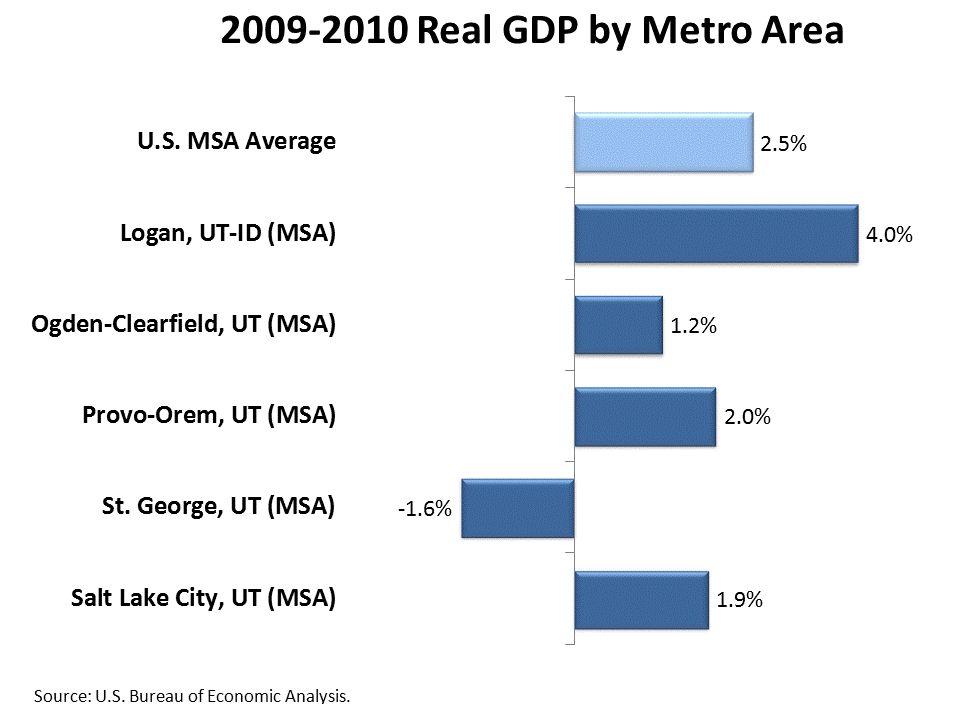
Most of Utah's Metropolitan Statistical Areas experience GDP growth in 2010
In Utah, growth also dominated the figures with only the St. George, UT MSA displaying an annual decline in real GDP (down 1.6 percent). In general, GDP growth in Utah's MSAs registered below average. The Logan UT, MSA showed the most rapid expansion (4.0 percent).
For more information about the 2010 GDP figures for MSAs, click here.